

Commercial real estate development in Harris County carries significant upfront costs. Moving beyond standard dry detention basins and implementing low impact development offers a direct financial advantage. Developers can offset their construction expenses by securing Houston green infrastructure tax abatements.
The City of Houston actively rewards property owners who manage stormwater on-site. The Green Stormwater Infrastructure (GSI) Tax Abatement program offers up to a ten-year reduction in property taxes on the increased value of the site. Qualifying for this financial incentive requires strict alignment between your engineering team and municipal planners early in the design phase.
Qualifying for Municipal Tax Incentives
Earning these abatements demands proven volumetric retention. The city expects your site plan to capture and treat rainfall directly at the source. Implementing permeable interlocking concrete pavement, expansive bioretention cells, and green roofs helps your site meet the required hydrologic thresholds.
Your design team must submit comprehensive site plans detailing how these decentralized assets function together. The city evaluates the total percentage of the site dedicated to nature-based flood mitigation. Reviewing the EPA green infrastructure funding opportunities helps your financial team identify exact federal and local tax benefits available for sustainable commercial builds.
Calculating the Financial Return on Investment
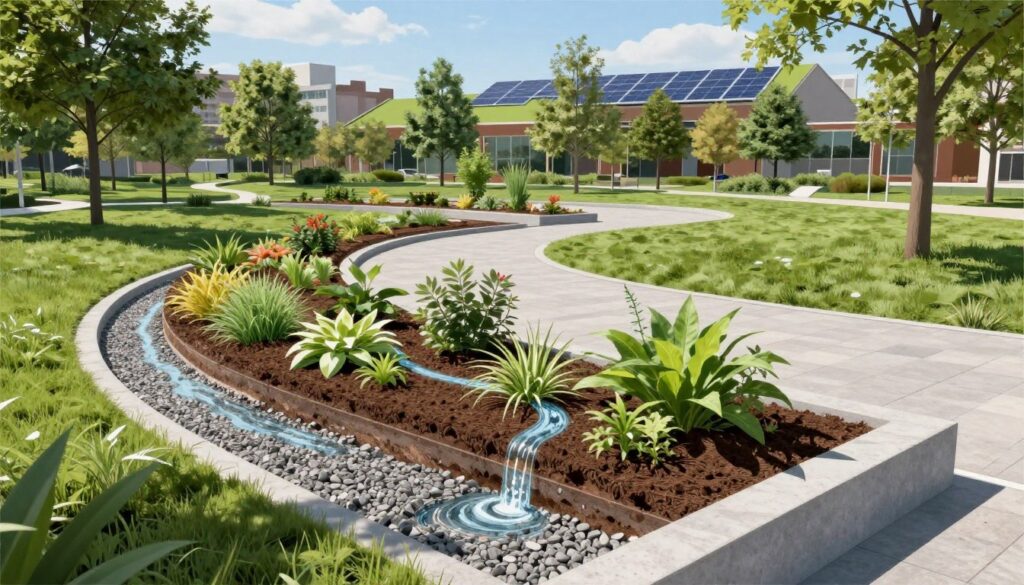
Replacing massive underground concrete vaults with surface-level rain gardens reclaims buildable land. Developers gain more leasable square footage, directly increasing the overall profitability of the commercial property. The tax abatement program layers on top of this reclaimed land value, creating a highly favorable return on investment.
Firms must submit a detailed cost-benefit analysis alongside their permit applications. The analysis compares the construction and maintenance costs of a traditional gray drainage system against the proposed low impact development model.
| Infrastructure Strategy | Land Consumption | Tax Abatement Eligibility | Long-Term Financial Benefit |
| Traditional Dry Detention | High (Requires dedicated basin) | None | Standard property taxation |
| Surface Bioretention | Low (Integrated into landscaping) | Eligible for 10-year abatement | Increased leasable space |
| Underground Geocellular | Zero (Located under parking) | Eligible for partial abatement | Maximum surface monetization |
Examining local green infrastructure case studies reveals exactly how Houston developers structure these cost comparisons to win municipal approval. The data consistently shows that decentralized surface features cost less to install and maintain over a thirty-year lifecycle.
Submitting the Required Engineering Documentation
City reviewers scrutinize every hydrologic model submitted for tax abatement consideration. Your civil engineers must provide continuous simulation modeling proving the site can handle back-to-back storm events. Accurate calculations depend entirely on using local precipitation frequencies.
Design teams must base their void space and drawdown rate projections on the specific clay soil profiles found beneath the site. Relying on the design criteria published by the Harris County Flood Control District prevents your submission from being rejected for inaccurate regional data. The city will immediately deny any tax abatement application that uses generic national rainfall averages.
Passing this technical review secures the financial incentives needed to make commercial green infrastructure profitable. Properly documenting the environmental and economic benefits keeps your development timeline intact and maximizes the final property valuation.