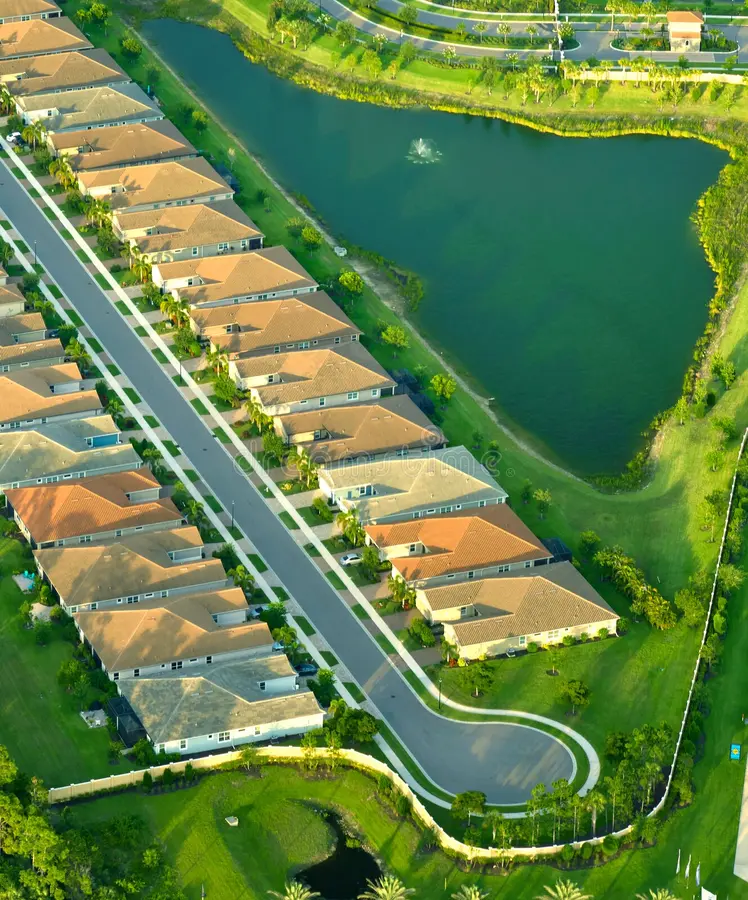
Residential cul-de-sacs present a massive hydrologic problem for municipal planners. These large circular dead-ends require massive amounts of asphalt to accommodate emergency vehicle turning radii. This wide, impermeable footprint collects and funnels thousands of gallons of rainwater directly into a single central storm drain, frequently causing localized street flooding during severe Gulf Coast storms. Applying cul de sac green infrastructure corrects this design flaw by forcing the street itself to absorb and filter the runoff. Civil engineers replace standard concrete circles with active stormwater management systems, easing the burden on aging municipal pipe networks. You can review federal green street design frameworks to see how the Environmental Protection Agency recommends structuring these neighborhood assets to capture rain exactly where it falls.
Converting the Center Island for Biofiltration
Many suburban cul-de-sacs feature a raised concrete or grass center island. Developers traditionally treat this space as an afterthought, planting a single tree and relying on crowned asphalt to push water away from it. Modern civil engineering flips this geometry. Designers depress the center island, creating a bowl-shaped bioretention cell. Strategic curb cuts allow street runoff to flow directly into the center planting bed. The water pools temporarily and percolates through layers of engineered soil and organic mulch, trapping suspended solids and automotive pollutants before they reach local waterways.
Harris County’s expansive clay soils complicate this natural absorption process. Without proper modification, a depressed island quickly becomes a stagnant pond. Engineers solve this by specifying exact organic material ratios to replace the native clay. Reading our technical articles provides the specific soil blending formulas required to keep these infiltration basins functioning year-round. Municipalities often reference the National Association of City Transportation Officials (NACTO) guidelines to standardize the dimensions and safety features of these retrofitted bio-islands, protecting both the infrastructure and local drivers.
Implementing Permeable Pavement Turnarounds
Some neighborhood layouts lack the physical space for a center island. Fire departments demand strict turning clearances, meaning the entire cul-de-sac must remain flat and drivable. In these scenarios, engineers replace traditional asphalt with permeable interlocking concrete pavement. The surface supports heavy sanitation trucks and fire engines while allowing rainwater to pass directly through the joints into a deep aggregate sub-base.
| Design Element | Traditional Cul-de-Sac | Green Infrastructure Cul-de-Sac |
| Surface Grading | Crowned to push water to the edges | Sloped inward to an infiltration zone |
| Center Island | Raised and sheds water | Depressed to collect and filter water |
| Pavement Type | Impermeable asphalt | Permeable pavers with aggregate sub-base |
This subsurface reservoir holds the stormwater, delaying the peak flow that normally overwhelms street-level catch basins. The structural sub-base must balance this hydrologic storage with massive physical load requirements.
Addressing High-Volume Storm Overflow
A well-designed biofiltration island handles standard summer rain seamlessly. A category four hurricane requires a completely different engineering response. Green infrastructure must integrate safely with traditional gray infrastructure to prevent the cul-de-sac from overflowing into adjacent residential driveways.
Engineers place an elevated overflow drain near the center of the bioretention cell. Once the engineered soil reaches maximum saturation and the water level rises to a specific height, the excess volume spills into this drain and routes directly into the municipal deep-tunnel system. Planners use rigorous 2D hydrodynamic modeling to identify the exact minute this transition occurs. Civil designers rely on structural pavement standards published by the ASCE to verify the surrounding sub-base will not wash out when the system hits this absolute limit. Building these hybrid systems protects private property while significantly improving neighborhood water quality.