

The Precinct 4 investment announced on October 28, 2026, changed the local infrastructure picture for several west Harris County communities. Commissioner Lesley Briones announced $80.2 million in partnership infrastructure investments under the Places 4 People initiative, with the stated purpose of advancing public safety and flood protection in Precinct 4, according to the Harris County Precinct 4 announcement.
The public value of the announcement is best understood through the project types and the neighborhoods named by the county. The work was described as a set of roadway, drainage, intersection, connectivity, flood mitigation, park access and pedestrian safety projects. A local report citing the announcement said the project package is expected to benefit about 525,000 residents across Alief, Cypress, Gulfton, Katy, Lazybrook/Timbergrove, Sharpstown, Uptown and nearby neighborhoods, as reported by Space City Daily.
The Precinct 4 investment matters because the listed work connects routine civic needs that are often discussed separately: safer crossings near schools, drainage capacity, bayou bank repairs, shared-use paths, road links and access to parks or transit. The announcement did not provide completion dates in the research record available here, so residents and civic organizations should treat the October 28, 2026 action as a funding and project-selection point rather than a construction-completion notice.
What The Precinct 4 Investment Covered
Precinct 4 Investment Funding Split
The funding structure is central to the policy significance of the announcement. Of the $80.2 million total, $18.4 million was identified as coming directly from Precinct 4. The remaining $61.8 million was attributed to partner organizations, including the City of Houston, Tax Increment Reinvestment Zones, Municipal Utility Districts and nonprofits. That mix means the county precinct is not acting alone; it is using a partnership model to assemble funding across public and civic entities named in the announcement.
For the Precinct 4 investment, the partner share is larger than the precinct share. That does not, by itself, prove cost savings or performance outcomes. It does show that the selected projects depend on coordination among separate local institutions. For residents, the practical question is not only how much money was announced, but which entity manages each component, how public updates are issued and where design or construction decisions will appear on public agendas.
Places Named In The Announcement
The announcement named multiple areas across Precinct 4 rather than a single corridor. The listed communities and areas included Alief, Cypress, Gulfton, Katy, Lazybrook/Timbergrove, Sharpstown and Uptown, with adjacent neighborhoods included in the stated service area. That geographic spread is significant for civic review because benefits are likely to be experienced differently by location. A sidewalk or school-crossing project in Alief has a different day-to-day use pattern than a bayou bank repair or shared-use path connection near Uptown.
The project package also fits into the broader Places 4 People record since 2023. According to the announcement, Precinct 4 and partners have invested $332.6 million in 69 infrastructure projects under that program. The announcement attributed 61 percent of that total, about $203.5 million, to external partners, while Precinct 4 contributed $129.1 million. Those figures provide useful scale, but they should not be read as a substitute for project-by-project status reports.
Road, Drainage And Crossing Projects
Westgreen And West Little York
One of the larger road and flood-related items named in the research record is the Westgreen Boulevard and West Little York Roadway Improvements project. The county announcement described it as a partnership with Municipal Utility District 105. The project includes a new bridge over Bear Creek and is intended to create a route from subdivisions including Lantana, Jasmine Heights and Settlers Village to FM 529 and the Grand Parkway.
The flood-protection relevance of that project is specific: the crossing was described as designed to remain functional during high water events. That wording should be read carefully. It supports the conclusion that high-water performance is part of the project purpose, but it does not provide a public construction timeline, engineering standard or post-storm performance outcome in the research record. Residents affected by Bear Creek-area mobility should watch for engineering documents, drainage criteria and construction notices from the responsible public bodies before assuming final design details.
School And High-Injury Corridor Safety
The announcement also included a Safe Routes to School project totaling $3.26 million. The project was described as improving pedestrian safety at three intersections near six schools in Alief and Greater Sharpstown. In civic terms, that is a targeted use of infrastructure funds for children, families, school staff and nearby residents who cross streets as part of daily routines.
Another pedestrian safety item was described as a roughly $1.02 million City of Houston project at five critical intersections in Alief, Gulfton and Sharpstown. The listed improvements include High-Intensity Activated Crosswalks, Rectangular Rapid Flashing Beacon crossings, ramps, sidewalks and improved crosswalks. The announcement supports the conclusion that the work is focused on safer crossings and accessibility features, but it does not establish crash-reduction results or construction completion dates in the material provided here.
Shared Paths, Bayou Repairs And Park Access
Uptown To Northwest Transit Center
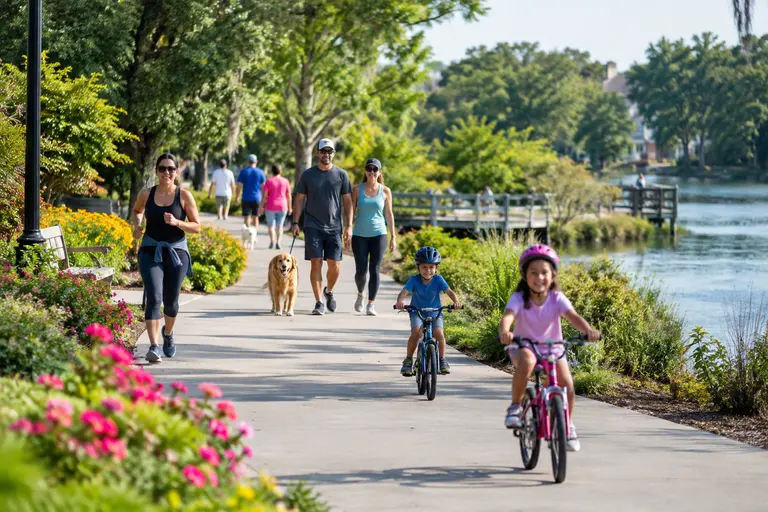
The largest single dollar figure named in the research notes is a $33.8 million partnership with Tax Increment Reinvestment Zone 16. The project was described as constructing a 2.5-mile shared-use path connecting Uptown, Loop 610 West, Memorial Park, the Houston Arboretum and the Northwest Transit Center. The same item includes stormwater storage and repairs to Buffalo Bayou banks.
This combination links recreation, access and flood-related infrastructure. A shared-use path can serve people walking, rolling or biking, while stormwater storage and bayou bank repairs address water-management needs listed in the announcement. Still, the available research does not state the design capacity of the stormwater storage or provide the repair schedule for the bayou banks. Those details are the next layer of information residents should seek through public project pages, board materials or partner-agency notices.
Alief And Keegans Bayou Links
Two smaller trail and path projects were identified in the announcement. The Keegans Bayou Connectivity Project was listed at $900,000 for the design of a 1.33-mile shared-use path that includes crosswalks and ramps. The Alief Connectivity Improvements project was also listed at $900,000 and was described as building a 0.35-mile shared-use path linking Alief, Meadows Place and other trails.
Those projects are smaller than the Uptown path partnership, but they are useful indicators of how the Places 4 People approach includes shorter neighborhood links. For local civic groups, the design details matter: crosswalk placement, ramp alignment, connections to existing trails and maintenance responsibility will shape whether these links serve daily access needs. For organizations comparing public-private and civic partnership models, the resources available through the Richland Chamber may offer insightful context regarding regional networks outside the immediate Harris County project scope.
Civic Checks For The Precinct 4 Investment
Tracking the Precinct 4 investment should begin with the distinction between announced funding and delivered infrastructure. The October 28, 2026 announcement identifies funding amounts, partners, project names and stated purposes. It does not, in the research record provided here, include detailed construction schedules, procurement milestones, final engineering drawings or maintenance agreements for each project.
Residents can use a simple civic review framework as these projects move forward:
- Confirm which agency or partner is responsible for each project component.
- Look for public meeting notices, agenda items or project pages tied to design and construction decisions.
- Check whether drainage, crossing and shared-use path details match the needs described in the announcement.
- Ask for timelines when none are posted, especially for school-area safety and high-water route projects.
The strongest supported finding is that Harris County Precinct 4 announced a large, partner-funded package aimed at public safety, flood protection, crossings, drainage, connectivity and park access across multiple communities. The more cautious finding is that public benefit will depend on implementation details not included in the announcement record summarized here. A useful civic response is steady monitoring rather than assuming that every announced improvement has already reached residents on the ground.